The Call That Said “HOME”
A suspenseful short story about a Sunday call, a message meant for someone else, and the moment you stop delaying what matters.
Storytelling Life Lessons
1/1/20264 min read
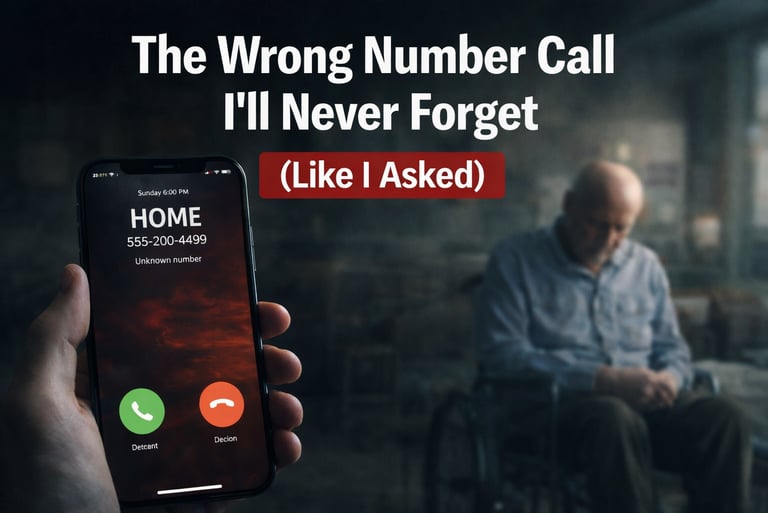
On Sunday at 6:00 PM, your phone buzzes like it always does.
No name. No photo. Just a number you’ve never saved… and a single word under it that makes your stomach tighten.
HOME.
You don’t answer.
You never do.
Because the first time it happened, three weeks ago, you were halfway through dinner, telling yourself you’d call back when you had time. The second time, you were driving, and the ringing felt too deliberate, too patient, like whoever it was already knew you wouldn’t pick up. The third time, you stared at the screen until it stopped, and the silence afterward felt louder than the call.
Tonight, you let it ring again.
Then, as always, a voicemail appears.
You tap it, expecting nothing. Maybe a wrong number. Maybe spam. But the message starts with a soft click, like an old recorder waking up.
A man’s voice comes through—low, careful, like he’s speaking in a place where sound matters.
“Hey,” he says. “If you’re hearing this… it means you still have a choice.”
You sit up.
The voice doesn’t sound angry. It doesn’t sound like a scam. It sounds tired. Human.
“And I know you’re busy,” he continues, “so I’ll keep it short. There are two kinds of days. Days you remember… and days that become your life.”
Your thumb hovers over the screen.
A pause. You can hear breathing. Then:
“Call someone back. Not tomorrow. Not when it’s convenient. Tonight.”
The message ends.
You replay it. Same click. Same tone. Same strange calm, like the voice isn’t trying to scare you, but it still does.
You check the number.
It’s local. Your area code.
You tap “Call back.”
It rings once, twice—then a recorded message: This number is not available.
You try again. Same thing.
Now the call feels less like a coincidence and more like a door you weren’t supposed to open.
The next day, you do what you always do when something makes no sense—you try to rationalize it. Maybe it’s a prank. Maybe someone fat-fingered your number. Maybe your phone glitched.
But all week, you find yourself listening for buzzing. Checking the top of your screen like you’re expecting the word HOME to appear again.
You tell yourself you won’t be scared next time.
Sunday arrives anyway.
6:00 PM.
Buzz.
HOME.
This time, you answer.
“Hello?” you say, trying to sound normal.
There’s a brief silence on the other end. Then a different voice—female, startled, like you caught her mid-thought.
“Oh—” she says. “I’m so sorry. I… I didn’t think anyone would pick up.”
You blink. “Who is this?”
The woman exhales. You can hear background noise—soft, steady beeping, the faint shuffle of a hallway.
“My name is Elena,” she says quietly. “I’m a volunteer at Pine Ridge Care. I’m calling from our community phone. I… I think I have the wrong number.”
You swallow. “Then why does it say ‘HOME’?”
A pause.
“It… shouldn’t,” she says. “That’s not… hold on.”
You hear her fingers moving across something, like buttons. Then she speaks again, softer.
“Are you… are you Ethan Miller?”
Your throat goes dry.
“No,” you say. “No. I’m not.”
Another pause, heavier this time.
“I’m sorry,” she whispers. “It’s just… he asked me to try one more time. Every Sunday. At six.”
“Who asked you?”
Elena’s voice drops like she’s afraid of being overheard.
“A resident here,” she says. “Mr. Harold Miller. He can’t use his hands very well anymore. But he made recordings… and he asked me to send them to his son. He said his son would recognize the voice. He said the calls had to say ‘HOME.’”
You stare at the wall, suddenly aware of how quiet your place is.
“I’m not his son,” you repeat, but it comes out weaker.
“I know,” Elena says gently. “I’m realizing the number might be off by one digit. Or… maybe he remembered it wrong. He’s been holding onto it for years.”
You close your eyes.
“Can I ask you something?” you say.
“Yes.”
“What’s in the next recording?”
Elena hesitates. “He asked me not to listen. But… I heard a piece by accident.”
You wait.
She speaks like the words are fragile.
“He said… ‘If you’re avoiding me, I get it. But please don’t avoid your life.’”
A chill runs through you—not because it’s spooky, but because it’s true in a way you didn’t expect a stranger to say.
You don’t know Harold Miller. You don’t know his son. But suddenly you’re thinking about the calls you haven’t returned. The texts you “meant to answer.” The names you scroll past like you’re saving them for a future you assume you’ll get.
Elena clears her throat. “I’m sorry for bothering you.”
You inhale, slow and steady.
“You didn’t,” you say. “Actually… thank you.”
There’s a quiet relief on the line, like she’s been carrying something heavier than a phone.
Before you hang up, you ask, “Elena… is he still there?”
“Yes,” she says. “He’s still here.”
You nod, even though she can’t see it.
After the call ends, you sit for a long moment, staring at your contacts. Your thumb moves to a name you haven’t tapped in months.
And for the first time in a long time, you don’t wait for the perfect moment.
You press Call.
Because one story didn’t just change your mind.
It changed your next decision.